
The author gratefully acknowledges the input of B. A. Engel in the preparation of this article - firstly as translator, and secondly for sharing his experiences as an anosmic Autist.
1. Introduction
Since the late 20th century, educators, researchers, and therapists have been exploring the potential of Virtual Reality (VR) to improve the daily lives of people affected by cognitive and sensory impairments (Burdea & Coiffet, 1993; Klinger, 2014; Fallet et al., 2022). VR digitally generates and simulates a safe environment in which the user, wearing a headset, is fully immersed to engage in sensorimotor exploration within a world that can simulate reality (Duris et al., 2023, p. 155). Among these possibilities, an innovative approach focuses on the sense of smell in a virtual environment. Within this field of investigation, the Participe 3.01 scientific programme, using immersive technologies, supports the autonomy of a vulnerable population with Autism Spectrum Disorder (ASD), Intellectual Developmental Disorders (IDD), and language disorders. In France, autism affects 700,000 individuals, or approximately 1% of the population, a third of whom – including the participants in our study – do not have access to functional verbal language (Baghdadli et al., 2012; Patten et al., 2013). ASD is characterised by impairments in communication and social interaction, stereotypical behaviours, a relatively narrow set of interests, and sensory atypias (WHO, 2022): visual, tactile, auditory, proprioceptive, vestibular, gustatory, and olfactory perceptions are altered in diverse ways, significantly impacting the individual’s relationship with the world (Bellusso et al., 2017; Pieron, 2022). To address these vulnerabilities, we felt it was essential to investigate the atypical sensory experiences of autistic learners in virtual reality, both to ensure their wellbeing from an ethical standpoint2 – a state of calm with a sensory affordance (Simonian, 2014) – and to stimulate their cognitive processes: could personalisation based on areas of interest, including olfactory ones, enhance learning and the associated memory pathways?
Despite the abundance of literature on ASD and VR, to our knowledge, very few studies have addressed this intersecting perspective (Lacôte-Coquereau & Richard, 2024). Our article therefore raises major questions:
- To what extent can an immersive VR environment support the learning processes of autistic participants with communication difficulties and atypical psychosensory perceptions? (Alin, 2019; Bogdashina, 2020).
- Among the sensory receptors involved, could the olfactory channel serve as a heuristic vector, highlighting the relevance of embodied cognition?
To address these questions, our discussion will be structured around the following themes:
- A theoretical framework dedicated to olfaction and autism, viewed through the lens of virtual reality;
- Comprehensive methodology and epistemology;
- Results of the exploratory research;
- Concluding perspectives.
2. Theoretical Framework: Olfaction, Autism, and Virtual Reality
2.1. Autism and Olfaction: An Atypical Sensory Experience
Historically, the sense of smell has remained a neglected sense among humans – notoriously unloved, blamed, and underestimated by elites and philosophers alike. In the 18th century, Immanuel Kant railed against scent: ‘Which organic sense is the most ungrateful and also seems to be the most dispensable? The sense of smell. […] Smell is taste at a distance, so to speak, and others are forced to share the pleasure of it, whether they want to or not. And thus smell is contrary to freedom’ (Kant, 1798, pp. 63–64). In the 19th century, the bourgeoisie recoiled from urban miasmas tainted with the stench of sin, going so far as to seek out the ‘olfactory silence’, so to speak, of purified atmospheres (Corbin, 1982). Yet the sense of smell holds an infinite array of virtues whose allure is well known to chemists, parfumiers, oenologists, historians, and distillers throughout the ages (Lardellier, 2003).
In autism, which is our focus, the olfactory system plays a particularly significant role. Due to autistic disorders, the sense of smell is altered, and smells are perceived in specific ways – sometimes greatly diminished (anosmic hyposensitivity) or, conversely, very intense (hypersensitivity). Hypersensitivity indicates an increased sensitivity to odours, leading the body to respond excessively to olfactory stimuli (Bogdashina, 2020). It occurs when olfactory information is perceived as overwhelming or too intense. This leads to a marked aversion to certain public places, public transportation, perfumes, or foods (Schovanec, 2012). While some Autistics3 may perceive no olfactory sensations4 at all, others may feel overwhelmed to the point of nausea, dizziness, or discomfort. Donna Williams’ hyperosmic reaction to certain perfumes made ‘the inside of [her] nose feel like it had been walled up with clay up to [her] eyebrows’ or ‘burned [her] lungs’ (Williams, 1996).
Conversely, the hyposensitivity associated with ASD creates a powerful urge to inhale certain smells in order to compensate for reduced olfactory perception, leading to a surprising relationship with the environment. It is not uncommon for some children with ASD to sniff people and objects in order to identify them. ‘Sensory processing systems are sometimes so distorted that touch and smell are the only two senses that provide reliable and accurate information to the brain’ (Grandin, 2008, p. 103). Many consider the senses of touch and smell to be more reliable, capable of compensating for their ‘temporary blindness.’ Some people seek to repeatedly inhale fragrances that evoke pleasant memories. This craving for scents can offer a source of comfort and, furthermore, a way to override other painful sensory stimuli in the daily environment (e.g. lights, sounds, touch…). ‘Certain noises perceived as far too loud trigger intense anxiety, to the point of paralysing internal functioning. This causes a sort of neural blackout that makes it very difficult to think or function’ (Schovanec, 2012, pp. 111–112). ‘Loud noises and, at the same time, bright lights—that was more than enough to overwhelm my senses. My head felt tight, my stomach knotted up, and my pulse raced until I found a safe space’ (Willey, 1999, p. 28).
Shedding light on these accounts, Olga Bogdashina’s work on ASD has highlighted a sensory integration dysfunction (SID), defined as ‘a disruption in the process of input, organisation, and output of sensory information’ (Bogdashina, 2020, p. 213). The brain’s ability to properly process and filter sensory input is impaired, leaving the individual drowning in an unstoppable sensory and cognitive tsunami. ‘Overload had set in […] My ship was sinking and no one knew’ (Williams, 1998, p. 95).
To address these significant challenges, behavioural therapies designed to help individuals cope with anxiety-provoking situations have been developed using olfactory mental images, combined with repetitive sounds or ‘cue’ words. It has been demonstrated that multisensory neurons integrate multimodal information, thereby creating multiple synapses in brain circuits (Yu et al., 2010). Aromatherapy – another therapeutic approach – aims to provide both mental and physical relaxation by stimulating the senses of smell, touch, and proprioception (Bogdashina, 2020, p. 252). Several studies highlight the sense of wellbeing experienced by autistic patients following sessions combining tactile pressure zones and personalised scents (Longhorn, 2010). Although experimental, these practices offer avenues for helping individuals with ASD live happier lives, and better understand their sensory atypicality.
2.2. Autism and VR: A Sensory Environment with Affordances
Regardless of the educational approach, sensory interventions are essential for the wellbeing of individuals with autism, and necessary for their education (Bogdashina, 2020, p. 276). The literature shows that individuals with ASD exhibit a particularly keen interest in digital technologies, which are our focus here (Nadel, 2021; Bourdon, 2022). According to Philippe Fuchs, a pioneer of immersive environments in France, the purpose of virtual reality is to enable sensorimotor and cognitive activity in an artificial, imaginary, or symbolic three-dimensional world that simulates certain aspects of the real world (Fuchs, 2018). Despite the fascinating appeal of the technologies involved, it is fundamentally important, in Fuchs’ view, to advocate an anthropocentric ethical approach: ‘Humans are at the centre of the system because they are the target audience of the virtual application. Based on this observation, it is desirable to adopt an anthropocentric (human-centred) approach rather than a technocentric (computer-centred) one’ (Fuchs, 2016, p. 23). In this theoretical framework, emphasis is placed on the active user, driven by the potential of a virtualised environment tailored to their needs, in terms of psycho-sensory affordance. Affordance is ‘that space-time of possibility, the result of a relationship between two entities’ (Simonian, 2014, p. 104; Gibson, 1977). From this perspective, digital technologies generally prove beneficial in educational and therapeutic contexts (Neely et al., 2013; Shane & Albert, 2008). With regard to autism, it is a learning-support tool that warrants further investigation.
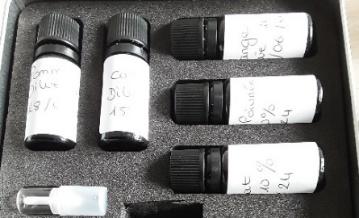
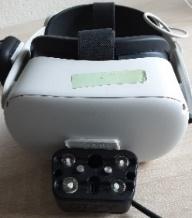
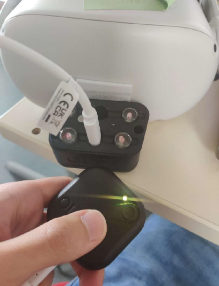
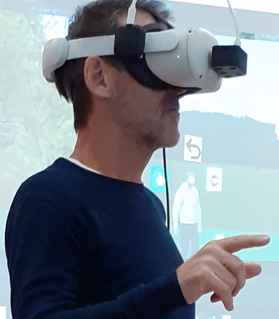
As we have seen, autistic learners often struggle to process simultaneous streams of information. To mitigate these sensory disruptions, VR offers the opportunity for a stable, reproducible learning environment free of external distractions (noises, people coming and going, unexpected intrusions, bright lights), all of which are factors that hamper attention. In this streamlined environment, autistic users can find a unique space in which to relax while taking an active role in their own exploration (Duris et al., 2023, p. 157). In addition to being appealing to this audience, VR offers ‘new spaces for interaction and expression in which they can be immersed’ in complete safety (Klinger, 2014, p. 57); akin to a spatio-temporal heterotopia. Within the research setup, audio and visual cues were reduced to accommodate users’ needs. Five levels of sensory stimulation (brightness, sounds, movements and scents) were offered during the VR scenarios. Each level was gradually increased or decreased by the research team based on the reactions of the autistic participants. It should be noted, however, that the olfactory modality, which was not previously accessible to the scientific consortium, was only introduced at the end of the programme. In VR, olfaction represents one of the virtually unexplored avenues currently under study worldwide (Lacôte-Coquereau & Richard, 2024). With a module built into the VR headset, it is now possible to release scent molecules in sync with immersive scenarios5 (Figure 1).
Figure 1: Scent diffuser module for the virtual reality headset
|
Scent capsules - Virtual reality headset |
Scent diffusers fitted to the outer casing of the VR headset |
Source: ©Participe 3.0.
The unit, which contains several spray bottles, is attached to the virtual reality headset, close to the user’s face. To avoid causing discomfort, the spray – which is activated by means of the connected computer – is extremely fine. It is released on demand or with the user’s consent. From an ethical and epistemological standpoint, this precaution seemed essential, ensuring the effectiveness of the participatory research.
‘But, when nothing remains from an ancient past […] smell and flavour, alone, frailer but more vivacious, more immaterial, more persistent, more loyal, stay for a long time, like souls’ (Proust, 1919, p. 48). What influence might smells have on the memory-based learning of young people with autism supported by the research programme?
2.3. Olfaction: A Universal Language from Birth
Retronasal-olfaction, evident from birth (Candau, 2000), is a physiological mechanism that allows the olfactory system to perceive aromatic characteristics. For every child, whether autistic or not, olfactory exchange and stimulation begin as early as the foetal stage, via the amniotic fluid, where olfactory receptors are activated (Schaal, 1997). Much of this learning occurs through self-directed exploration starting in the sixth month of foetal development through exposure to the mother’s smelly substances ‘that challenge our brains and make their mark upon them’ (Jaubert, 2024, p. 22). At a rate of 32 inhalations and exhalations of smelly mixtures per minute, we continuously accumulate olfactory signals throughout our lives – some 1.5 billion over an 80-year span (Jaubert, 2024, p. 15)!Research into the neurophysiology of olfaction suggests that depriving oneself of the powerful emotional resonance of scents would amount, for humans, to ‘cutting oneself off from an essential connection to the world’ (Holley, 1999, p. 251). According to that author, two dimensions correspond to the olfactory channel: a ‘cognitive dimension’ driven by olfactory signals and a ‘motivational dimension of sensory stimuli’ (Holley, 1999, pp. 247–248).
Given how crucial motivation is for learners with ASD to engage in educational activities, this dual olfactory dimension deserves full consideration.
Olfactory impressions, which are ‘individual symbols par excellence,’ carry ‘the ability to evoke memories and feelings removed from social communication’ (Sperber, 1974, p. 130); for a non-verbal audience, less inclined toward social interactions, this channel could serve as a particularly effective mnemonic vehicle. Using neuroimaging techniques (functional magnetic resonance imaging, fMRI), for the first time, a study examined the abstract link between linguistic and olfactory information. Control subjects passively read words associated with certain smells (‘garlic,’ ‘cinnamon,’ ‘jasmine’) followed by neutral language items. The results show that reading smell-related terms triggers activation in the primary olfactory cortex, including the piriform cortex and the amygdala. Words for smelly things activate the primary olfactory area without the need for verbalisation (Gonzalez et al., 2006).
Nevertheless, it is observed that many people with autism are unable to recall their memories unless they are (re)triggered. Voluntary access to encoding areas appears to be impaired and requires ‘triggers.’ Thus, their memory retrieval differs from typical (linear verbal) memory in its associative, multidimensional nature, triggered by stimuli such as colours, patterns, sounds, or smells (Bogdashina, 2020, pp. 167–168). Numerous accounts from autistic individuals confirm this associative or serial memory (Williams, 1996, 1998a). Neurobiologist Oliver Sacks describes an unbreakable link between the scene, temporality, and the initial context (Sacks, 1995). This phenomenon is brilliantly described by Donna Williams: ‘I would learn how to tackle a given situation in one context [such as standing with a woman in a kitchen] but be lost when confronted by the same situation in another context.’ (Williams, 1998b, p. 58).
Many people with autism do not recall details verbally but express the act of seeing, hearing, tasting, or smelling objects (in their minds). They store their memories in an atypical yet highly perceptive way (Bogdashina, 2020, p. 165). Although there is naturally an extreme variety of autistic profiles, there are reports of excellent photographic, auditory, or olfactory memories (Grandin, 1995; O’Neill, 1999).
Wendy Lawson describes an experience of scents so vivid that she could physically smell them over and over again: ‘It was so intoxicating, and I felt so alive’ (Lawson, 1998, p. 2).
What methodology can be used, then, while taking account of this unique sensory experience, to explore olfactory potential within an immersive environment conducive to learning?
3. Comprehensive Methodology and Epistemology
3.1. The Comprehensive Epistemological Paradigm
In any research endeavour, human vulnerabilities must be taken into account. Yet the vulnerable individual – as a meaningful subject possessing knowledge, power, and resilience – is too often undervalued, dismissed, or deliberately denied under the pretext of hierarchical legitimacy and/or scientific objectivity (Alin, 2018, p. 34). Owing to their socio-linguistic challenges, autistic individuals with communication difficulties sometimes disconcert practitioner-researchers, who implicitly turn to less unsettling populations. Seeking to overcome this ‘silencing’ – the social invalidation of atypical speech (Dotson, 2011) – requires profound epistemological reflection capable of transcending identity-based prejudices and viewing others as individuals on the cusp of emerging capabilities (Lacôte-Coquereau, 2024a).
In this sense, the Participe 3.0 programme is part of the tradition of participatory research, working closely with the stakeholders involved, regardless of their social invisibility (Bourdon, 2021). Participatory research represents forms of scientific knowledge production in which civil society actors participate actively and deliberately (French Ministry of National Education, Higher Education, and Research, 2017). It embodies the desire for ‘collective action’ to counter exclusion linked to disability. It places the participant at the heart of the research process. This anthropocentric approach, in both real and virtual environments (Fuchs, 2018), eliminates any inclination to view human beings as standardised, inert atoms.
In the social sciences, the epistemological landscape is characterised by two main paradigms: the explanatory paradigm, which is a conventional normative framework adopting a so-called objectifying stance, and the comprehensive paradigm, adopting a so-called participatory stance (Charmillot, 2017). The comprehensive paradigm aims to analyse experiences situated within an ecological context through a logic of discovery. It combines ‘ethical imperatives with the construction of open knowledge’ (Charmillot, 2017). As a holistic system, this paradigm appeared best suited to meet the needs of a unique autistic population with tangible vulnerabilities. Understanding others means relating an act not to the entirety of a scientific explanation of the world, but to the singularity of a learner-subject: ‘relating it to the meaning that I, personally, give to this act’ (Worms, 2023). From an autistic perspective, it is important to take account of the need for habituation (Lewis, 2009). The researcher’s immersion – two days and two nights a week for nearly three years6 – allowed for an in-depth exploration of the participants’ lived experiences, their interests, their difficulties, and their untapped potential. This long-term immersion – an epistemological approach fully embraced by the researcher – allowed her to observe exchanges among medical and social professionals, attend weekly meetings and interdisciplinary seminars, and participate in meetings with families, all of which facilitated a situated analysis and collaborative engagement. In qualitative research, the methodology of data triangulation allows for the seamless combination of a comprehensive approach to individual subjects in situ and scientific rigor (Denzin, 1989; Paillé & Mucchielli, 2016). Mixed methods, combining qualitative data (interviews, participant observation, interactional analysis) with quantitative statistical data collected via online surveys, have allowed unexpected insights to emerge (Lacôte-Coquereau, 2024b). However, we will present only a few aspects here, focusing on the exploratory olfactory dimension.
3.2. Research Cohort
The qualitative study within this research programme focuses on a vulnerable population that is under legal guardianship due to impairments in cognitive, social, or sensory functioning. The cohort consists of 8 young adults with Autism Spectrum Disorder, language disorders, and intellectual developmental disorders (WHO, 2022):
- 4 men, 4 women
- Average age: 23 years
- 6 out of the 8 participants cannot read or write
Current recommendations for supporting individuals with ASD are based on behavioural criteria, among which the assessment of sensory processing plays a significant role. Three internationally validated functional assessments were conducted here: the Autism Mental Status Exam (Grodberg et al., 2014), the Vineland-II (Sparrow et al., 2015), and the CPS-R sensory profile (Bogdashina, 2020; Degenne-Richard, 2014). All were conducted within the residential care facility. While several standardised tests exist to assess sensory integration dysfunction, most are administered in settings which are unfamiliar to the patients in their day-to-day lives, such as in the specialist’s office rather than in their own homes. ‘They do not assess the child in natural settings and are aimed only at identifying deficits’, though certain sensory experiences may prove to be exceptional strengths or superabilities (Bogdashina, 2020, pp. 257–258). In the realm of digital mediation, many studies on children with autism have been conducted in laboratories, neglecting ecological field experiences which would better reflect the reality of daily clinical practice (Duris, 2023, p. 151). Therefore, the research team, in collaboration with psychologists and the Centre de Ressources Autisme (CRA, Autism Resource Centre), opted for in-situ assessments in the participants’ daily living environments to gain the most accurate understanding of their profiles and potential.
Diagnoses highlight major communicative and sensory impairments that hinder social interactions. They also highlight olfactory variability (hypo- or hypersensitivity) depending on the participant (P). The reports from the various sensory tests conducted by the CRA, in addition to the observations made by the medical-educational team, note that: ‘P7 agreed to smell the scent cups. Her inhalation is deep and fresh. She was able to distinguish between sweet and savoury smells… P8 was able to say that she does not like the smell of fire’; ‘P4 sniffs her fingers, objects, and seeks out strong smells’; ‘P1 likes coffee; P1 picks and sniffs flowers’; ‘P3 enjoys the smell of coffee’; ‘P2 enjoys chocolate but grimaces and gags at the smell of meat’.
3.3. Anthropocentric Olfactory Protocol
The research is part of a long-term study spanning a three-year period (2021–2024). Following the researcher’s survey of the medical and educational teams (questionnaire, interviews, and focus groups), two VR scenarios were selected to enhance the autistic participants’ independence in their future apartments: shopping for and preparing a meal in a virtual supermarket and kitchen. To encourage engagement in the activity and enhance memory retention, five scents were selected based on the users’ preferences: apple, orange, coffee, chocolate, and mint. The educators – most of whom have been supporting the participants for several years – helped choose these five scents from the available range. Indeed, while engaging different sensory channels fosters greater immersive interaction (Vandromme, 2018), it is essential to take individual preferences into account: e.g. P8’s preference for apple at snack time, P2’s for chocolate, or P1 and P3’s for coffee after lunch.
To interact with participants with communication difficulties, the support of a third party is recommended (Bedoin et al., 2015). While wearing a VR headset, how can they express themselves when words fail? In the established protocol, a third-party educator – chosen by the autistic participant to ensure their trust – participates in the trials and assists them in their interactions with the virtual interface. The educator ensures the participant’s well-being and offers them the diffusion of the scent. The orthonasal route is used, where participants directly inhale the diffused scent. The selected fragrances help engage the patient in tasks related to their interests and life goals (in this case, the prospect of a new home). In the virtual supermarket, where everyone learns to navigate and shop independently, synthetic molecules corresponding to the selected foods are diffused (for example, orange and apple in the fruit and vegetables section), to help identify and memorise the corresponding aisles.
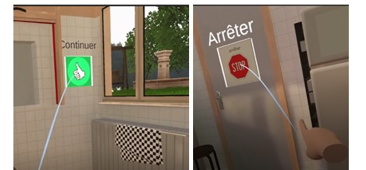
At any time, the participant can decide to stop or continue the trial either by speaking, by signing (Makaton), or by pointing to two self-determination pictograms, ‘stop’ or ‘continue,’ implemented for this purpose in the VR headset (Figure 2).
Figure 2: Virtual Reality Pictograms for Self-Determination
Source: ©Participe 3.0.
These two pictograms, which the educational team use on a daily basis, were chosen in consultation with the participants because they are universally understood. The pictograms offer an ethical alternative for participants with communication difficulties who are unable to verbally express their emotional state (Lacôte-Coquereau, 2024b). For the researcher coordinating and attending each virtual reality session, these pictograms serve as an indicator of how participants are responding to the olfactory experience: pleasure, disgust, saturation, or wellbeing. Although participants speak little or not at all, subtle facial expressions (smiles, grimaces, tension, etc.) provide explicit insight into their percepts during the immersive session.
4. Exploratory Results
4.1. Immersive Olfaction: A Motivational Memory Vector
As previously noted, only 3 out of 28 VR trials were able to incorporate the olfactory modality by the end of the three-year research programme (2021–2024). This innovative technology, which has only been commercially available since 2022, allowed a scent diffuser unit to be attached to the VR headset. The results presented here are therefore preliminary and exploratory. Nevertheless, from the very first experiments, the verbatim comments, facial expressions, and gestures of the users – observed live by the researcher or during the retrospective analysis of recorded sessions (Alin, 2010) – reveal sensations of pleasure during the diffusion of smells (Figure 3).
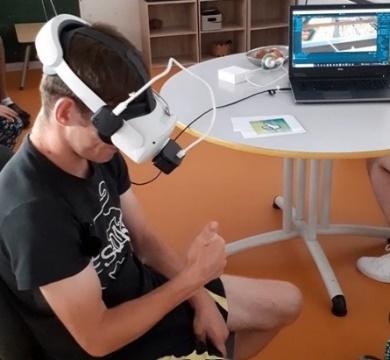
Figure 3: Gesture of assent by participant P1 after scent diffusion in VR
Source: ©Participe 3.0.
To make allowances for the participants’ partial silence and collect as much data as possible, all sessions were filmed in real time and in the researcher’s presence using two cameras: an intrasubjective camera integrated into the VR headset7, and an extrasubjective camera positioned in a wide shot behind the participant, facilitating the researcher’s review of the footage. Two olfactory experiments involving autistic participants (P1 and P2), which were particularly significant, recorded in July 2024, are presented here.
4.3.1. Olfactory Experiment with P1
Anonymous participant P1 is a 21-year-old man diagnosed with moderate language disorders and autistic traits. He has been institutionalised since early childhood, and his relationships with the educational team are built on trust. Digital technology is one of his particular interests. In fact, he participates very regularly in virtual reality sessions. After his second olfactory immersion, P1 shares his impressions with the guiding educator (G):
P1 – ‘I smelled… it smells like coffee in there, that’s nice… it makes me want to… Apple, yeah, that’s good (smiles and gives a thumbs-up8). Orange, that smells good… that’s nice, it makes me want to go shopping.
G - Do you remember the smells from the headset?
P1- Yes, chocolate and coffee
G - And the fruits?
P1- Apple, orange’
Due to speech difficulties, the lexical register used to express olfactory sensations is limited and unsyntactic. However, the memory of ‘the smells of the headset’ is explicit and links the memory to the evocation of pleasure: ‘that smells good.’ Like the ‘involuntary memory’ illustrated in the well-known ‘Proust’s madeleine’ episode, which evokes memories of a lost childhood, olfactory reminiscence serves as a starting point for gradually unravelling a web of associations. Like an unconscious game of Shiritori9 or cascading dominoes, the perceived scents here help revive the associative or serial contextual memory characteristic of autism: ‘it makes me want to go shopping.’ For a long time and for all living beings, philosophers and anthropologists have emphasised the importance for perceptual consciousness of the combination of signals transmitted through different sensory channels (Lévi-Strauss, 1964; Cassirer, 1972). Do smells not possess the secret power to affect people without their knowledge, to discreetly influence their decisions, and to stimulate their mental capacities? (Holley, 1999, p. 173). ‘A fragrance can exist not only as olfactory particles, but through thought alone. It is enough simply to remember it’ (Sekiguchi, 2024, p. 17).
4.3.2. Olfactory Test P2
Anonymous participant P2 is a 23-year-old woman diagnosed with severe praxic and language disorders (nonverbal). She has been institutionalised for several years but spends her weekends with her family. She enjoys the immersive sessions and, despite her motor and language difficulties, consistently asks to participate. In the virtual supermarket, the guiding educator offers P2 a chocolate scent, which she particularly enjoys:
G: ‘Do you want some chocolate?’
P2 - Mmm (nods, agrees)
G - It’s going to smell like chocolate now’ (scent diffusion).
P2 - Pause as the scent is released. P2 is focused. No grimace, no postural withdrawal. With a pointing gesture, P2 selects the box of chocolate from the virtual shelf. She exclaims, laughs at her success, and claps loudly (Figure 4).
Figure 4: Selection of chocolate after scent diffusion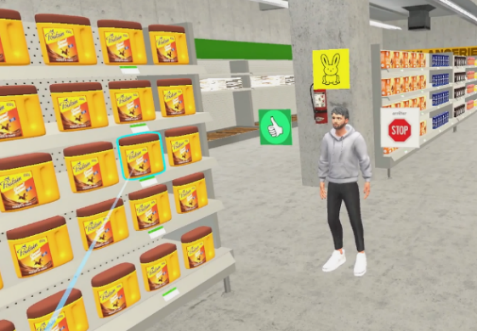
Source: ©Participe 3.0.
In P2, we observed that the olfactory stimulation led to increased processing time, concentration, and visual attention, resulting in selective pointing at the chocolate in the VR environment. It is important to note here that, for this participant, the deictic gesture of pointing in the VR involved an extremely lengthy process of motor learning (21 months); pointing, which is rare for P2 and cognitively demanding, therefore, demonstrates a genuine desire for the selected product. The fact that P2 was able to point at the box of chocolate – through a fine-motor, complex, and non-automated gesture – shows the user’s strong desire to obtain the coveted object (likely reinforced by the chocolate scent).
Studies show that the memory trace of an experience consists, in part, of sensorimotor information (such as smell and pointing) present during initial learning. ‘The representation of a concept, and more generally of knowledge, requires the reactivation of the sensorimotor brain patterns that were activated during the actual experience’ (Dutriaux & Gyselinck, 2016, p. 430). In line with embodied cognition, other authors emphasise the importance of sensorimotor systems for the conceptual system and memory (Varela et al., 1993; Damasio, 1994). We can therefore expect that the engrams10 – the olfactory memory traces of the chocolate scent released during P2’s olfactory session – may have helped reinforce learning in the VR. Are olfactory memories not just as fragrant as the scent molecules floating in the air around us? (Sekiguchi, 2024, p. 185).
As mentioned earlier, the mnemonic dimension triggered by olfactory signals beginning in intrauterine life (Candau, 2000) is reinforced by a genuine ‘motivational dimension’ when the perceived or imagined scents resonate with the individual’s own desires, tastes, and gustatory pleasures (Holley, 1999; Lardellier, 2003). The anthropocentric, non-technocentric epistemological approach (Fuchs, 2016) employed in this research therefore appears to be essential when considering an autistic audience. Professionals and studies dedicated to ASD report that ‘personalisation based on areas of interest is a prerequisite for fostering spontaneous engagement in learning activities’ (Renaud & Cherruault-Anouge, 2018, p. 140).
5. Concluding Remarks
Ultimately, the study’s results confirm that VR artefacts can promote engaged activity11 in autistic individuals with communication difficulties (Lacôte-Coquereau et al., 2023). They highlight the need for an immersive environment designed with sensory affordances to enhance cognitive availability, wellbeing, and, consequently, learning. With respect to the olfactory dimension, the exploratory research highlights two important aspects:
- scents, when they resonate deeply with the subject’s aspirations and interests, promote cognitive engagement and associative memory consolidation;
- while technology facilitates deep sensory immersion, it cannot be ethically justified without an anthropocentric epistemology that respects the participant (Lacôte-Coquereau, 2024c).
Ultimately, while the initial results are encouraging, the next step is to replicate these immersive olfactory modalities with a broader audience. The small sample size (eight adults, only half of whom were able to experience the novel device) and the limited number of olfactory trials conducted constitute one of the limitations of this research. Individuals with ASD exhibit specific perceptual and behavioural characteristics and cannot be reduced to the generic model often advocated in scientific circles: ‘an immediate universal knowledge’ (Sensevy et al., 2018, p. 112). However, it is now established that ‘even in a single individual, hypotheses can be substantiated based on indications that recur repeatedly’ (Passeron & Revel, 2005). While the case of autistic olfaction is unique, it opens up a new realm for reflection. As such, it holds great relevance, to be explored beyond previously uncharted boundaries.
‘She sensed something timidly scratching at her door. […] A tiny crack had opened in the darkness… Sometimes she would catch a fleeting suggestion of coffee. She clung to these faint scents’ (Sekiguchi, 2024, p. 102).
What if, in the area of autism where words cannot easily be articulated, scents could help create new impressions of presence (Lacôte-Coquereau, 2024b), new strategies for memorisation and communication; heuristic educational bridges attuned to the individuals’ Otherness?
Ministère de l’Éducation nationale, de l’Enseignement supérieur et de la Recherche. (2017). Charte des sciences et recherches participatives en France. Alliance Sorbonne Université (ASU). https://www.science-ensemble.org/charte-engagements-valeurs

